How Does NeuroRecall Work?
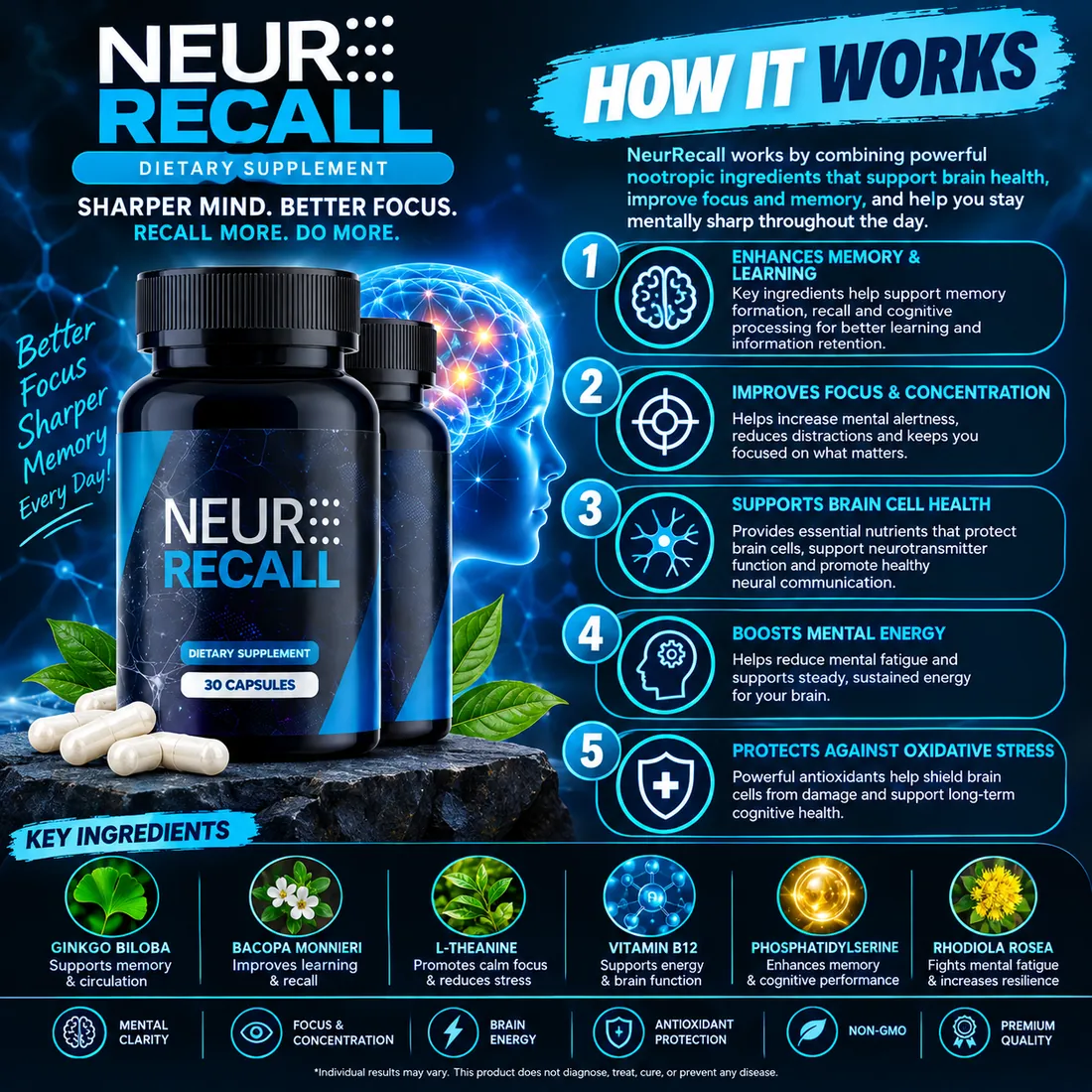
Answer: NeuroRecall works nutritionally, along three tracks: blood flow to the brain (Ginkgo), the structures memory is built on (Bacopa, phosphatidylserine), and steady calm energy (L-theanine, vitamin B12, Rhodiola). One capsule a day is absorbed through digestion, and support builds over weeks, focus first and memory later.
First, how a memory is made
A memory is a pattern of neurons that has learned to fire together. Each time the pattern repeats, the connections between those cells, the synapses, get slightly stronger and easier to trigger. That process needs blood flow to deliver oxygen and glucose, intact cell membranes to build new branches, and enough energy inside each cell to keep the signals moving. Focus is the brain choosing which patterns to fire and holding off the rest. The National Institute on Aging describes how all of this changes with age.
Track one: blood flow
Ginkgo biloba is included for circulation. Its compounds relax small vessels and reduce the stickiness of platelets, which is why it is studied for attention and memory and also why it must not be combined with blood thinners without medical approval (NCCIH).
Track two: the building blocks of memory
Bacopa monnieri is the slow worker. Its bacosides appear to support dendrite growth, the branching that lets neurons form new connections, and trials show gains in recall after eight to twelve weeks (PubMed). Phosphatidylserine is a structural fat in every neuron's membrane, where the sending and receiving actually happen.
Track three: calm energy
L-theanine raises alpha-wave activity, the relaxed-alert rhythm, within about an hour, so it is the ingredient people feel first. Vitamin B12 keeps nerve insulation and cellular energy metabolism running; low levels are a common, reversible cause of fog. Rhodiola rosea is studied for mental fatigue under stress (PubMed).
The dose reality
A single capsule holds roughly 500 to 700 mg in total across six ingredients. Bacopa trials use 300 mg of extract; phosphatidylserine trials 100 to 300 mg; ginkgo 120 to 240 mg. Six research doses do not fit in one capsule, so some ingredients are at supportive rather than trial levels. The exact split is on your bottle's panel, and we call the formula daily support, not a clinical stack.
A realistic timeline
| Weeks 1 to 2 | L-theanine's calm focus is often noticed; nothing else should be expected yet. |
|---|---|
| Weeks 3 to 5 | Steadier afternoon energy is the next thing customers mention. |
| Weeks 6 to 8 | The window for judging recall, and the decision point inside the 60-day guarantee. |
| Month 3 and on | Bacopa trials run to twelve weeks; long-term customers describe cumulative, modest benefit. |
Next: every ingredient and caution, or our evidence check on Bacopa and memory.
Eight weeks, one capsule a day
The three-bottle pack gives you 90 days at the NeuroRecall discount price of $69 a bottle.
Order NeuroRecallRelated questions
Does NeuroRecall work immediately?
L-theanine can be felt within an hour or two as calmer focus. Memory support is slow and should be judged over about two months.
Is it a stimulant?
No. There is no caffeine. Steady energy comes from B12 and Rhodiola, not from a stimulant.
Will it work without sleep and exercise?
Do not expect it to. Sleep, movement and learning drive brain health far more than any supplement.